


I talk about the military frequently. Even though I served for only five years, SO MUCH happened that was primarily negative, and I want to talk about those things I haven’t gotten to talk about with people who will understand. Just the fact that you’re autistic (or someone who loves an autistic) makes me feel safe to share this stuff. Whether or not you were/are in the military—no matter what country you’re from—I think you’ll be able to relate to some of this because it is, after all, about my struggles with working...with other people.
After graduating from high school, I had big dreams. I was certain that I was going to become an entomologist. That was until I realized I was absolutely terrified of bugs. I loved to study them from afar, but up close was a no-go. It didn’t take long to figure out that a career in bugs wasn’t the best fit for me.
Not long after I came to this realization, I found myself sitting in a recruiter’s office. I’d taken the ASVAB weeks earlier, and my scores revealed which professions I’d qualify for. From the options given, I narrowed it down to Security Forces (military police) and the Command Post. I wasn’t interested in chasing down “bad guys”; I just wanted to work in a place where I could use my mind more than my body. Cuz I be lazy. And I enjoy sitting. The Air Force is also known as the Chair Force because the majority of professions are desk jobs. I told the recruiter to sign me up for a Command Post position.
For clarity, the Command Post is both the heart and headache of a base. It’s the nerve center. Nearly everything goes through it first. Whether it was the logistics of incoming flights or the mundane “Who’s on shift today?” queries, it all landed in our laps. And oh did it keep us busy. The Lakenheath, England, Command Post was the only one I knew, other than the one I worked at during one of my deployments. Each shift had a senior controller and a junior controller. The junior controller took the majority of the calls and did most of the work; the senior controller carried a 9mm to shoot anyone who tried breaking into the classified materials safe. They also made most of the decisions. I was a junior controller until my last two years. In the first year of service, I couldn’t even work in the Command Post because my top-secret clearance hadn’t gone through yet, which I’ll chat about another time. But being a senior controller was initially boring since the juniors did the work, so I made sure to do my fair share, which is why people liked working with me.
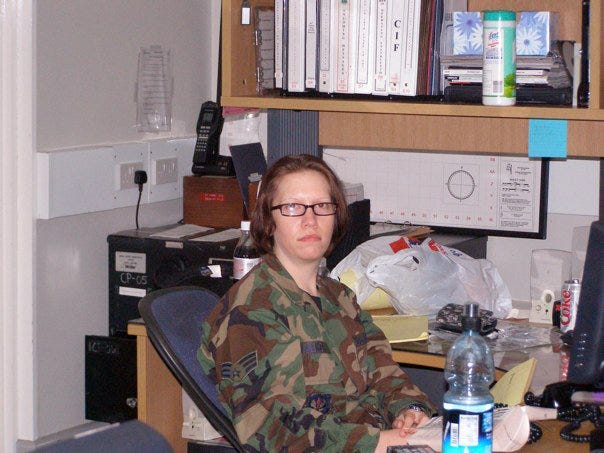
So, in the early 2000s, I found myself stepping into the concrete jungle of the military. It was like being thrown into a world where time was measured in PT sessions and acronyms ruled the land. In this picture, I’m 19, in uniform, looking about as unhappy as an autistic person in a crowded grocery store. Was it because I was miserable with the military life or just that moment in particular? Maybe a bit of both.
The truth is, working at the Command Post was like being on a rollercoaster that never stopped. Every day, without fail, was filled with surprises. I’m not a fan of surprises because I like to know about something before it happens, so this was quite the adjustment. It could be a domestic violence situation, a house on fire, somebody stealing from the Commissary, protestors at the gate were unruly, etc. You never knew what call you’d get, and you always had to be prepared for the worst.
What kept me going was the structure. Every task, every action, had a checklist. I thrived on that. As an autistic person, structure is like a life raft in a sea of chaos. It’s not just helpful, it’s essential. It’s like having a GPS when you’re lost in a city you’ve never been in before. Without it, I’d have been adrift. I had a knack for remembering the details of the job that my coworkers often forgot. I also enjoyed the shift work. I was able to work odd hours, which helped me better manage my time. It was normal to do two days (0630–1430), then two swings (1430–2230), followed by two nights (2230–0630). I liked the variety.
Yet, there was something that made my job super difficult: my coworkers. I was not a fan of people. All they did was talk, talk, talk. Complain, complain, complain. I cannot stand when people continuously bitch about the same issue but don’t identify possible solutions to the problem. I also couldn’t stand when know-it-alls were actually know-nothing-at-alls and wanted to tell me how to perform a task the wrong way. Then I’d point out that their way was wrong and mine was not, and suddenly I had an “attitude.” I wish I had known back then that I’m autistic. Humans were definitely my biggest challenge. Still are. I found it difficult to relate to them. Still do. They often didn’t understand my unique way of thinking, and I didn’t understand their obsession with following DUMB orders and strict adherence to ASININE rules. I often felt like an outsider because I was still an out-of-the-box thinker, which the military doesn’t like. (Hence the brainwashing they do on recruits at Basic Training. I’m thinking it doesn’t work too well on autistics.)
Another challenge I faced was the constant sensory overload. The Command Post was always busy, and the steady stream of people and information was overwhelming. I often found it challenging to concentrate and focus on the task at hand. Big lights, loud mouths, and incessant beeps from the fax machine or the top-secret phone or the top-secret computer, or someone is at the gate and wants to come inside. For obvious reasons, my favorite shifts were the overnight ones. There were only the two controllers in the entire building and not as many sounds. Being a senior controller, I got to control the lighting and made sure it was dim until the morning shift rolled in. Fuck the perks of being the one in charge; I just wanted to work a full shift without getting a headache from the bright fluorescents.
As a result of the instability and sensory stuff, I regularly burned out and didn’t understand why. It was still going to be about twenty years before I found out about the ’tism. I also felt like I was more intelligent than most of my coworkers, some of whom had been in the Air Force for fifteen-plus years and bordered on retirement. Maybe it was because I could see patterns that they couldn’t, or maybe it was just my particular brand of weirdness. Either way, I felt like an alien. What a weird conundrum. As much as I wanted to fit in, I didn’t want to fit into that way of living. Blindly following shitty orders and not being encouraged to think differently? No thanks.
And honestly, I did have a bad attitude the first year or so. Not sure what I was thinking the military would be like, but I didn’t particularly appreciate being told what to do all the damn time. I talked back to my supervisor quite a few times until he couldn’t take it anymore and proceeded to berate me as I stood at attention in an otherwise empty office. He screamed in my face that I was a dirtbag airman and all kinds of other shit, so loud that the entire building heard every single word. That is not how you talk to a subordinate, military or civilian. So disrespectful and, in my case, a bit traumatic because I completely altered my behavior after that incident. It was so humiliating that I turned inward and didn’t speak unless it was about work.
Because I became so quiet, people started asking if something was wrong. I politely informed them (except for the one person I liked and befriended) that I would only talk to them if it was work-related. Even the supervisor who screamed at me. It brought me great joy that he disagreed with my decision and couldn’t do anything about it. Wasn’t that what he wanted, for me to be more professional? When people broke my boundary, I stared so hard at them that my friend called it “the Walker” cuz Walker is my last name, and we all referred to each other by last names as though they were first names. Back then, it didn’t make me uncomfortable that I was making someone else feel uncomfortable. I relished it. It was my way of saying “fuck you” to all the assholes. To this day, I’m still baffled that people’s feelings get hurt at work when the issue doesn’t have anything to do with work at all, but with the fact that some people just don’t want to listen to other people’s bullshit. It’s called work for a reason; it’s a job where you’re paid to work, not gossip. But good news: I don’t have to perform the Walker anymore since I work from home.
I can’t say this was the most glamorous introduction to my military stint or that it’s even that unique. There are probably thousands of people who have had similar experiences. But it’s my story. It’s the story of a young unaware-that-she’s-autistic woman who found herself in the military (just kidding), who faced challenges and overcame them (by overcame, I mean I got the fuck out of the military), and who ultimately came out the other side stronger and more resilient (true).
I have stories for weeks about the Command Post and other aspects of the military that I’ll share here and there. I’m so far removed from the military that I have no idea if they even know what autism is or support those who identify as autistic. Because of my checkered past with the Air Force, I lean more on the side that they don’t care too much about autism. I hope I’m wrong.
Forever rebellious,
Autistic Ang
Want a one-stop shop for all things adult autism? Check out my brand-new online course here.